TOTE: .eco champion
Sometimes what prevents people from recycling is as basic as having the right bags to put waste in and carrying it across the street. TOTE helps households clear that barrier.
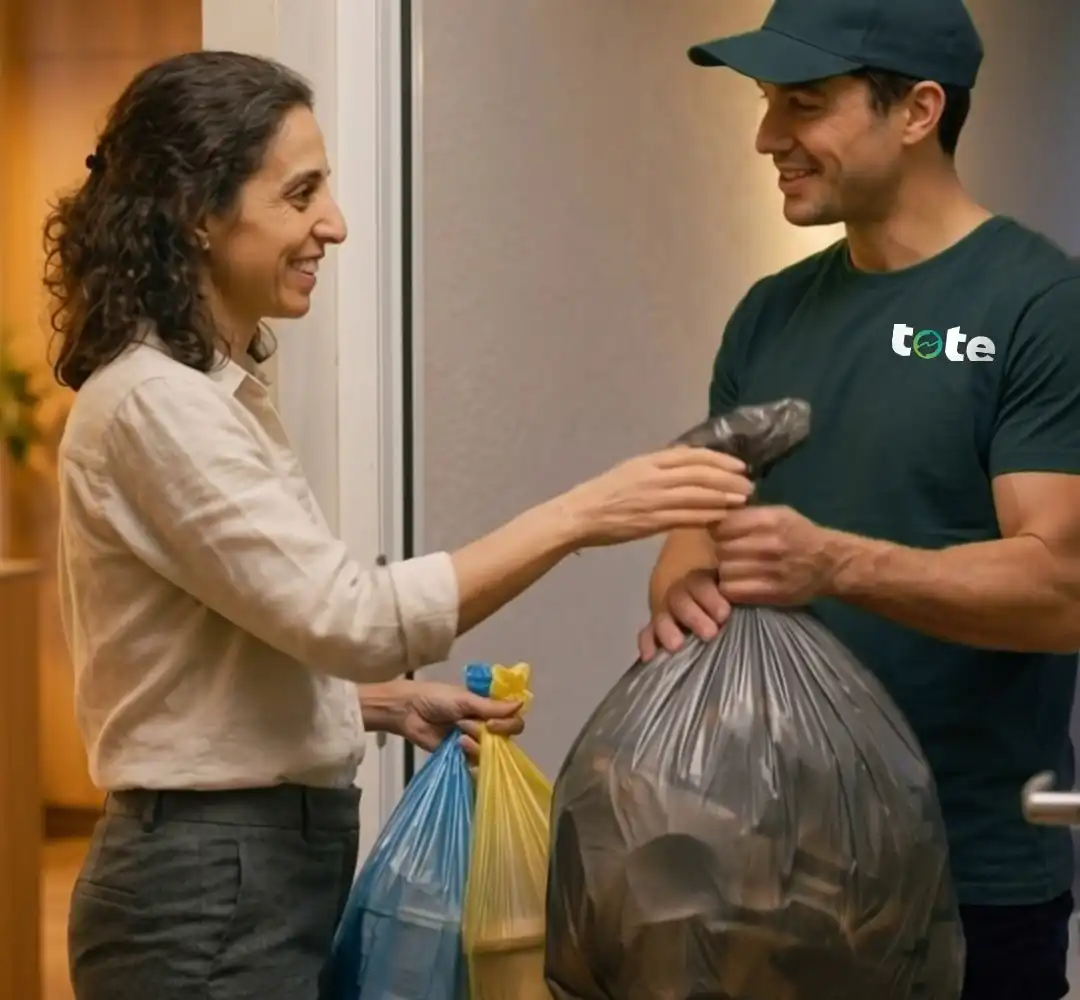
We spoke with Nuno Mendes, founder of TOTE, a service that makes recycling easier for households by collecting sorted waste directly from their doorstep.
What is TOTE?
TOTE is a household waste service running in Portugal. The name says what it does: TOTE stands for Take Out Trash Ecologically.
People sort their waste at home into the four Portuguese streams: paper and cardboard, plastic and metal, glass, and general waste. A subscription covers a set of collection days each week, chosen by the customer. On those days, one of our couriers picks the bags up, either from the door or handed over in person, and places each one in the correct municipal container.
Customers can subscribe with TOTE bags, which are shipped to them by post and replenished before they run out, or with bags of their own at a lower price. Everything else is handled from their account: the collection calendar, moving a specific pickup to another day, bag balance, billing, and a panel showing the environmental impact of what they have separated.
Why did you decide to launch TOTE?
Because I watched the idea fail a few metres from my own front door.
In 2017, a neighbour of mine tried to run something like this by hand for my building and one or two next to it. She took people’s separated waste to the containers for them, and she supplied the bags. What defeated her was the bags — though not in the way you would guess. She kept no record of who had been given what, so a fresh roll went out whenever somebody said they had run out. The cost climbed until it stopped making sense. One day she stopped supplying bags altogether and everyone left.
That is the lesson TOTE is built on. Separating well asks three things of a household at once:
- having the four right bags within reach,
- not running out of them mid-week,
- and the time to take each stream to the right container.
Fail one and the habit dies. But the service supplying those bags has to count them, or it is the service that dies first. So we count them, and anyone who would rather use their own pays less.
How does TOTE handle the waste and recyclables it collects?
The most useful thing I can tell you is what we do not do. We do not sort it, we do not store it, and we do not treat it. Nothing we collect leaves the municipal system.
The sorting happens at home, by the customer. Three of the four streams are recycling: paper and cardboard, plastic and metal, and glass. The fourth is the general waste left over, which we collect too, although putting waste in a bin is not separating and we do not claim otherwise.
On the chosen day, the courier picks the bags up and places each one in the correct municipal container. That is the whole journey: from the door of the flat to the container across the street, a walk the resident would otherwise make themselves. What we take out of the equation is the walk, not the system behind it.
Our couriers are not employees. They work on their own account and invoice us for the collections they choose to take. They do not open bags, re-sort them or correct mixes. Before taking collections they pass a waste separation questionnaire with eighty percent required, and they are covered by civil liability insurance.
Why use TOTE instead of the waste and recycling services offered by the region or municipality?
You do not use TOTE instead of them. You use TOTE to use them.
The municipal system here is not the problem. The containers exist, they are close, and they take all four streams. What fails is the last stretch, between the kitchen and the container, and it fails for different reasons. In my own case, it is plain convenience, and I will admit it before anyone else does: I am lazy about the trip, and I doubt I am the only one. For an older resident or for someone with reduced mobility, it is not laziness at all. Carrying four separate bags down a staircase and across a road is exactly where the separating stops or never starts.
So TOTE is not a parallel collection. Every bag we pick up goes into the same municipal container the resident would have used. What changes is that somebody comes on a day the household chooses, week after week, to ensure that waste and recycling make it to the right bin.
Tell us about the impact reports you offer to your customers
Every customer has an environmental impact panel in their account, and it fills itself from their own collections.
It shows the total they have separated, the CO2 avoided, the water saved and an equivalent in trees, with a breakdown by stream: paper and cardboard, plastic and metal, and glass. Each equivalence explains itself, so the tree figure says it is based on long term CO2 capture by native trees, and the water figure says that recycling uses significantly less water than producing from raw materials. Behind it there is a history of past collections, and a share button, because people are proud of these numbers and that does more for separation than any argument we could write.
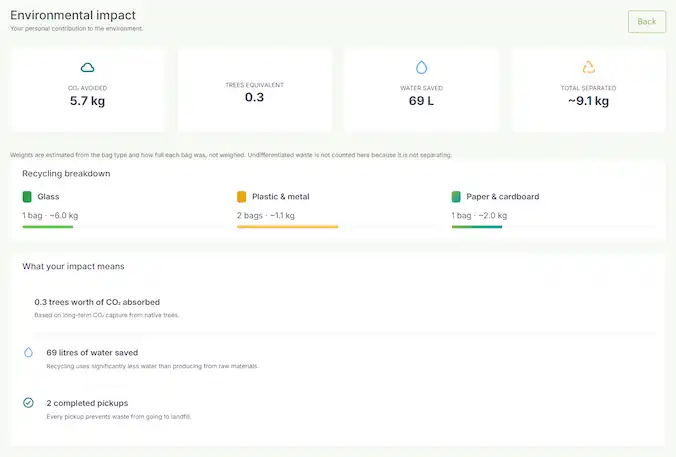
Two things we are deliberate about. The weights are estimated from the bag type and how full each bag was, and the panel says so, because we do not weigh bags and we are not going to pretend that we do. And general waste is not counted in the impact, because putting waste in a bin is not separating.
How did you learn about .eco and why did you choose a .eco domain for your site?
I already knew the extension existed before TOTE, and it came back to me when I sat down to register a domain. I looked at what was available, saw .eco in the list, and stopped there.
There were two reasons. The first is that it says what the company is before anyone reads a word. A waste service that needs a paragraph to explain itself has already lost the reader, and tote.eco does that work in the address bar.
The second one matters more to me. Most extensions sell you a name and ask nothing in return. To use a .eco you commit to an environmental purpose and publish it in a profile that anyone can go and read. Ours is at profiles.eco/tote, and it names the sustainable development goals we work towards. The trustmark sits in the footer of the site.
So it was never decoration. It was the one extension that asked us to say what we stood for, and we were glad to be asked.
At .eco, we are fortunate to be surrounded by a community of businesses, organizations and individuals working hard to protect our planet. We are honoured to spread the word about the great work they're doing. If you are a member of the .eco community and would like to be featured, get in touch.